In the hyper-connected landscape of the 2026 digital economy, the rarest commodity isn’t data, capital, or even talent—it’s focus. As we navigate an era defined by Slack notifications, endless Zoom cycles, and the algorithmic pull of social media, the ability to concentrate without distraction on a cognitively demanding task has shifted from a “productivity hack” to a fundamental economic necessity.
Cal Newport, who coined the term “Deep Work,” defines it as professional activities performed in a state of distraction-free concentration that push your cognitive capabilities to their limit. These efforts create new value, improve your skill, and are hard to replicate. Conversely, “shallow work” (logistical-style tasks like answering emails or attending status meetings) offers little value and is easily automated by AI.
The Economic Reality: The Law of Rare Skills
The modern workforce is undergoing a bifurcated evolution. On one side, we see the automation of routine cognitive tasks. On the other, there is an exploding demand for complex problem-solving, creative synthesis, and high-level technical mastery.
According to a study by the McKinsey Global Institute, the demand for higher cognitive skills—such as creativity and critical thinking—will grow by nearly 20% across all industries by 2030. However, our capacity to perform these tasks is being eroded. Research from RescueTime indicates that the average knowledge worker checks communication tools every 6 minutes, making it nearly impossible to enter the “Flow State” required for elite output.
For students and professionals alike, the inability to focus is more than a personal failing; it is a career bottleneck. Many students find themselves so overwhelmed by the “shallow” demands of modern life that they look for professional support, often searching for experts to do my college assignment for me just to reclaim the mental bandwidth needed for deep, specialized study.
The Science of Depth: Myelin and Cognitive Flourishing
Deep work is not just a philosophical preference; it is a neurological requirement for mastery. When you focus intensely on a specific skill, you trigger a process called myelination. Myelin is a fatty tissue that wraps around nerve fibers, acting as an insulator that allows electrical signals to move faster and more efficiently.
- The Deep Work Equation: High-Quality Work Produced = (Time Spent) x (Intensity of Focus).
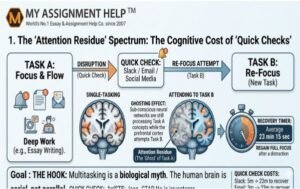
- The Attention Residue Effect: Professor Sophie Leroy of the University of Minnesota discovered that when you switch from Task A to Task B, your attention doesn’t follow immediately. A “residue” stays with the first task, meaning your brain is operating at sub-optimal capacity for the second task.
If you are constantly switching between a research paper and a group chat, you are essentially functioning with a temporarily lowered IQ. This is particularly relevant when preparing for high-stakes presentations or public speaking. Mastering Value Speech Topics requires hours of uninterrupted rehearsal and synthesis that “shallow” skimming simply cannot provide.
Why AI Makes Deep Work More Important, Not Less
There is a common misconception that Generative AI will make human focus obsolete. The opposite is true. As AI lowers the floor for “average” content and code, the market value of “average” drops to zero.
The “Alpha” in the modern workforce now lies in:
- Iterative Prompt Engineering: Deeply understanding a domain to guide AI toward non-obvious solutions.
- Complex Synthesis: Connecting disparate ideas that AI—which operates on probability rather than true “understanding”—cannot link.
- Strategic Vision: Determining what is worth doing in an ocean of automated output.
Strategies to Reclaim Your Focus
To cultivate the skill of deep work, one must move beyond “trying harder.” You must build a “Focus Ecosystem.”
1. The Bimodal Philosophy
Set aside clearly defined stretches of time for deep work (e.g., 4-hour blocks three times a week) where you are completely offline. Use the remaining time for your shallow, administrative tasks.
2. Grand Gestures
Sometimes, a change in environment is necessary to signal to your brain that “this matters.” This could be as simple as going to a library without your phone or as significant as booking a hotel room for a weekend of intensive writing.
3. Shutdown Ritual
Deep work requires intense recovery. Implement a strict “shutdown” time where you stop checking work communications. This allows the prefrontal cortex to recharge, ensuring you have the cognitive energy for depth the following morning.
Key Takeaways
- Deep Work is Rare: Most people have lost the ability to focus, making it a “superpower” for those who retain it.
- Depth Creates Value: High-level skills and elite output are products of intense, undistracted concentration.
- Avoid Multi-tasking: Attention residue from switching tasks can reduce cognitive performance for up to 20 minutes after the switch.
- AI is a Tool, Not a Replacement: AI handles the shallow; humans must provide the depth to remain competitive.
Conclusion: The New Competitive Advantage
In the 21st century, your bank account and your career trajectory will eventually mirror your ability to focus. As the world becomes louder, those who can retreat into silence to solve the world’s hardest problems will be the ones who lead. Depth is not just a way to work; it is a way to live a meaningful, productive life in a distracted world.
FAQ Section
Q: Can I do deep work while listening to music?
A: It depends. Research suggests that instrumental music (lo-fi, classical) can help maintain focus, but music with lyrics often triggers the language-processing parts of your brain, which can detract from tasks like writing or coding.
Q: How long does it take to build a deep work habit?
A: Most people find that it takes 2-3 weeks of consistent practice to “re-wire” their attention span. Start with 60-minute blocks and gradually increase the duration.
Q: Is deep work the same as “flow”?
A: They are related. Deep work is the effort and the scheduling of the task; Flow is the feeling of being lost in the work. Deep work is the reliable path to achieving a flow state.
Author Bio
Jane Doe is a Senior Academic Consultant and Content Strategist at MyAssignmentHelp. With over 12 years of experience in educational psychology and professional development, Jane specializes in helping students and corporate professionals optimize their cognitive workflows. She is a firm believer in the E-E-A-T framework and advocates for digital minimalism in the modern workspace.
References & Data Sources:
- Newport, C. (2016). Deep Work: Rules for Focused Success in a Distracted World. Grand Central Publishing.
- Leroy, S. (2009). “Why is it so hard to do my work? The challenge of attention residue when switching between work tasks.” Organization Science.
- McKinsey Global Institute. (2024). The Future of Work: Skill Shift and the Role of AI.
- University of California, Irvine. The Cost of Interrupted Work: More Speed, More Stress.