Introduction
In precision manufacturing projects, material selection serves as the critical first gate determining a part’s performance, cost, and lead time. Engineers and procurement managers often face a dilemma when navigating the vast array of CNC machining materials options: prioritizing high performance can derail budgets, while excessive cost control may compromise part reliability and longevity. This challenge typically stems from an insufficient understanding of the complex interplay between material properties, manufacturability, and the end-use application. Relying solely on traditional experiential selection or simple datasheet comparisons often overlooks crucial dimensions like production feasibility, supply chain stability, and total cost of ownership.
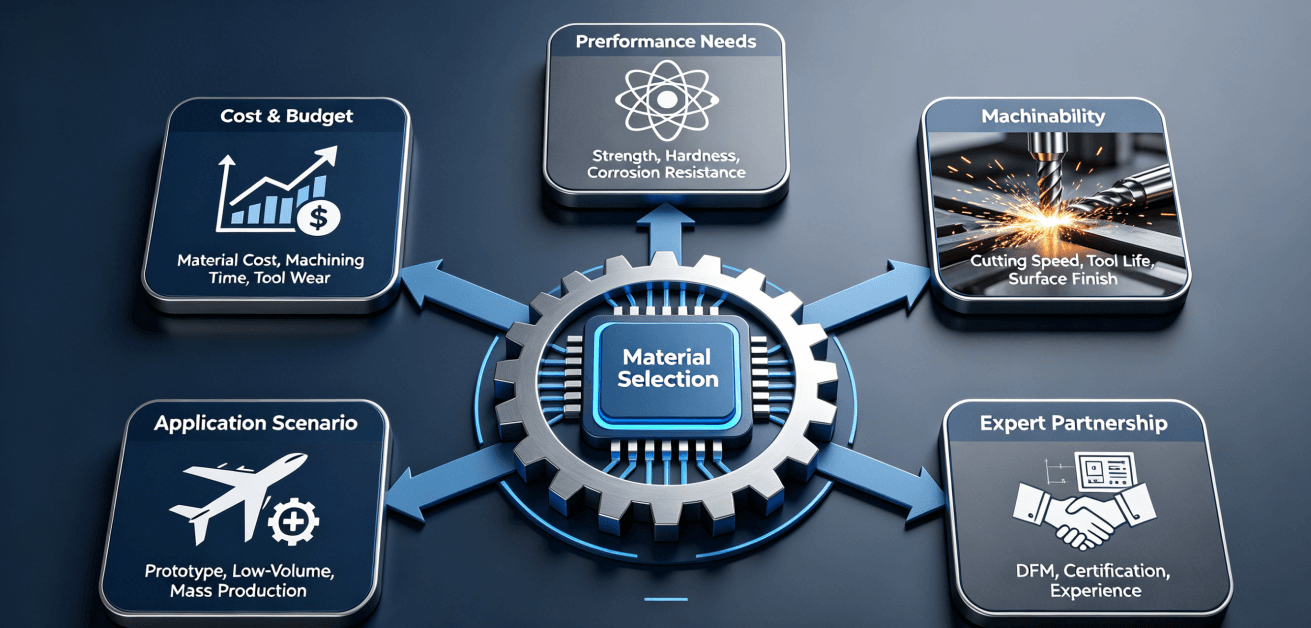
This article deconstructs the decision-making process for CNC material selection, presenting a systematic framework that integrates performance requirements, machining economics, and supply chain considerations. It will illustrate, through industry logic, how strategic material substitution can achieve cost reduction and efficiency gains. Understanding the following five core dimensions is key to making informed material decisions and avoiding project setbacks.
Why Can the Wrong CNC Material Choice Lead to Up to 40% Cost Overruns?
When evaluating the cost of CNC machining materials, focusing solely on the material’s price per kilogram is a critical mistake. The total cost comprises material procurement, machining time, tool wear, scrap rates, and post-processing expenses like heat treatment or coatings. A typical error is selecting a high-grade stainless steel over aluminum alloy for a structural component that does not require extreme strength. This compounds costs at multiple levels: first, the raw material cost for stainless steel can be several times that of aluminum; second, its poor machinability forces slower cutting speeds, significantly extending cycle times and accelerating tool wear; finally, its unfavorable chip-breaking characteristics can affect surface finish, necessitating additional quality checks and polishing steps.
More hidden costs arise from the chain reaction of poor machinability: a higher scrap rate means double waste of material and labor; repeated trial cuts and parameter adjustments delay project timelines; and premature part failure can even lead to customer service costs. Therefore, the key to achieving cost-effective CNC machining lies in conducting a full lifecycle cost-versus-performance analysis. When comparing an aluminum vs steel CNC milling quote, it is essential to inquire about the underlying assumptions for machining time, tool consumption, and yield rate to gain true insight into the total cost.
How Do Key Physical and Mechanical Properties Determine a Part’s Fate?
Selecting CNC Milling Materials is essentially about matching a part to its destiny. Core property indicators such as strength, hardness, toughness, corrosion resistance, thermal stability, and weight directly determine whether a part can perform in a specific scenario. Aerospace components pursue an ultimate strength-to-weight ratio, making titanium and high-end aluminum alloys preferred; medical implants require absolute biocompatibility and corrosion resistance, making 316L stainless steel and titanium the primary choices; automotive engine parts must maintain strength and wear resistance at high temperatures, leading to the use of specialty alloy steels.
When consulting a comprehensive guide to CNC milling materials, one finds distinct performance profiles across material categories: aluminum alloys are celebrated for their light weight, good strength, and excellent thermal/electrical conductivity; stainless steels are renowned for superior corrosion resistance and high strength; engineering plastics excel in weight reduction, insulation, and chemical resistance. However, one must not view any single champion property in isolation. A comprehensive assessment of the part’s real-world operating conditions is mandatory: is it under constant load or impact? Is the environment ambient, high-temperature, or corrosive? The ideal values on a data sheet must be combined with the practical processing and post-treatment capabilities of the manufacturing partner to translate into reliable part performance.
How Does Machinability Invisibly Impact Your Budget and Timeline?
Machinability measures how easily and economically a material can be cut into shape, silently yet profoundly affecting budget and delivery schedules. It encompasses cutting force, chip breakability, heat dissipation, and abrasiveness against tools. Many materials offer excellent performance but are budget killers due to poor machinability. For example, certain titanium alloys or high-hardness tool steels generate intense heat during machining and are extremely abrasive, forcing machines to use very low feed rates. This not only drastically increases machining time but also turns expensive specialized tools into rapid consumables.
Conversely, materials like 6061 aluminum, 12L14 free-machining steel, and C36000 brass, with their excellent chip-breaking and tool-friendly nature, allow machines to run at higher parameters, thereby greatly improving production efficiency and reducing per-part cost. This is crucial for ensuring the stability and economy of Precision CNC machining. Therefore, communicating early in the design phase with manufacturing experts to leverage their experience in selecting material grades or alternatives that are easier to machine while meeting performance requirements is a critical step in optimizing project outcomes. Understanding the breadth and depth of What materials can be CNC milled effectively is a key advantage of a specialized manufacturer.
How to Select the Optimal Material for Your Specific Application (From Prototype to Production)?
Prototyping and Testing Phases
In rapid prototyping, the core demands are low cost, high speed, and material availability. Therefore, plastics like ABS or PLA, or common aluminum alloys like 6061, are ideal for quickly validating design form and fit. For functional testing, materials must simulate the final part’s performance as closely as possible. This stage requires selecting specific alloy grades (e.g., 7075 for high-strength structures) or stainless steels based on expected loads and environment.
Production Phase Considerations
For low-volume production, a balance must be struck between performance, cost, and supply chain agility, often still using readily available be in common use materials. Upon transitioning to high-volume production, deep cost optimization is necessary. This involves considering long-term material supply stability and potentially customizing material specifications for the specific part to eliminate every ounce of unnecessary cost.
- The Classic Showdown: Aluminum vs. Steel
In the choice between Aluminum CNC Milling and steel parts, a perpetual trade-off exists between weight, strength, corrosion resistance, cost, and machining difficulty. Aluminum alloys (e.g., 6061, 7075) are renowned for their light weight (about 1/3 the density of steel), good specific strength, excellent atmospheric corrosion resistance, lower raw material cost, and superior machinability, making them the first for aerospace, consumer electronics, and lightweight structures. Stainless steels (e.g., 304, 316) offer higher absolute strength and hardness, and exceptional chemical corrosion resistance, but at the cost of greater weight, higher material cost, and more challenging processing. The choice ultimately depends on the application’s priority: is weight reduction and fast machining needed, or must the part withstand extreme loads or corrosive environments?
- Deepening Decisions with Professional Tools
Navigating the complex world of materials requires systematic guidance. For a more comprehensive comparison of material properties and a selection flowchart, refer to this detailed how to choose CNC milling material .
Why is Partnering with an Experienced Manufacturer the Most Critical Step in Material Selection?
A Database of Practical Experience Beyond Datasheets
The most valuable material selection knowledge often resides not in public data sheets, but within a manufacturer’s internal database. An experienced manufacturer accumulates countless case studies on materials’ real-world behavior: the deformation tendencies of different aluminum grades during thin-wall machining, the adhesion of surface treatments on specific stainless steels after various heat treatments, the hygroscopicity and dimensional changes of engineering plastics during machining. This tacit knowledge is key to mitigating risks and achieving first-time success.
Early Engagement and Value Optimization
A professional manufacturer can provide decisive input during the Design for Manufacturability (DFM) analysis stage. They might suggest replacing a through-hardened steel part with a free-machining steel coupled with local surface hardening, drastically reducing machining cost and time while maintaining wear resistance. Or, they may recommend a material with similar properties but better stock availability to shorten lead times. This early collaboration transforms the challenge of material selection into an opportunity for value optimization.
- The Significance of Industry-Specific Certifications
Choosing a manufacturer with comprehensive certifications is the most direct vote of confidence in their systematic capabilities. ISO 9001 is the baseline for quality management; IATF 16949 signifies that their system meets the automotive industry’s stringent requirements for reliability and traceability; AS9100D is the entry threshold for the aerospace supply chain, ensuring quality and safety under extreme conditions; and ISO 14001 reflects their commitment to environmental management, optimizing processes from the source to reduce material and energy waste.
- The sublimation of Partnership Value
Collaborating with a cnc milling factory that possesses full-range certifications and rich experience offers more than just a machining service. It provides a strategic partner who understands industry-specific language, anticipates potential issues, and transforms material selection from a technical hurdle into a competitive project advantage. Companies like LS Manufacturing, which hold ISO 9001, IATF 16949, AS9100D, and ISO 14001 certifications, exemplify this level of trusted partnership, ensuring quality, compliance, and efficiency from design to delivery.
Conclusion
Selecting materials for CNC machining is a multi-dimensional technical decision that profoundly impacts product performance, project economics, and market success. To make an informed choice, one must move beyond simple datasheet comparisons. A systematic evaluation from the perspective of the real application scenario, manufacturability, total lifecycle cost, and active collaboration with manufacturing experts is essential. This approach effectively mitigates risks and maximizes the value of every investment.
Is your next project at a material selection crossroads? Immediately submit your CAD drawings and performance requirements to a professional manufacturing partner to obtain a detailed quote and DFM report that includes alternative material analysis and cost-effective CNC machining solutions. Let professional insight safeguard your project’s success.
About the Author
The author of this article is a senior technical consultant in the field of precision manufacturing, with over a decade of experience in materials science and CNC machining applications. Dedicated to helping engineering teams solve complex manufacturing challenges, the author focuses on achieving the optimal path from design to mass production.
FAQs
Q1: What are the main considerations when choosing between aluminum and stainless steel?
A: The core trade-offs are strength-to-weight ratio, cost, and corrosion resistance needs. Aluminum is lighter, easier to machine, and typically less expensive; stainless steel is stronger, more corrosion-resistant, but heavier and more costly to machine. The decision should be based on a comprehensive assessment of the part’s load-bearing requirements, operating environment, and budget.
Q2: For medical components requiring high strength and good biocompatibility, are there more economical options than titanium?
A: For non-implantable instruments, a high-grade aluminum alloy (like 7075-T6) subjected to a special hard anodizing treatment is an excellent choice. It provides sufficient strength, excellent surface hardness, wear resistance, and sterilization resistance, while significantly reducing cost and lead time.
Q3: What are the main challenges in machining high-performance engineering plastics like PEEK?
A: The primary challenge is controlling heat buildup during machining, which can cause deformation. This requires specialized tool geometry, optimized cutting parameters, and cooling strategies to ensure dimensional stability and surface integrity. An experienced manufacturer is crucial for this process.
Q4: Besides the material itself, what other factors significantly affect the final cost and lead time of CNC parts?
A: Part geometric complexity, tolerance requirements, surface finish specifications, and order quantity are the main factors. Optimizing the design for manufacturability (DFM) to simplify machining and relax non-critical tolerances can effectively control costs and shorten timelines.
Q5: How can I get the most accurate CNC machining quote?
A: Providing detailed 3D CAD drawings is fundamental. A professional manufacturer will analyze the drawings for manufacturability, recommend materials, and estimate machining time to provide a transparent and accurate quote, which should include a breakdown of material, machining, post-processing, and logistics costs.